Literature · The Christian Library
George Herbert builds an altar
A poem’s shape can be part of its thought. Reading the stone, heart and sacrifice of Herbert’s ‘The Altar’.
Psalm 51:16–17 · Exodus 20:24–26 · Luke 19:37–40
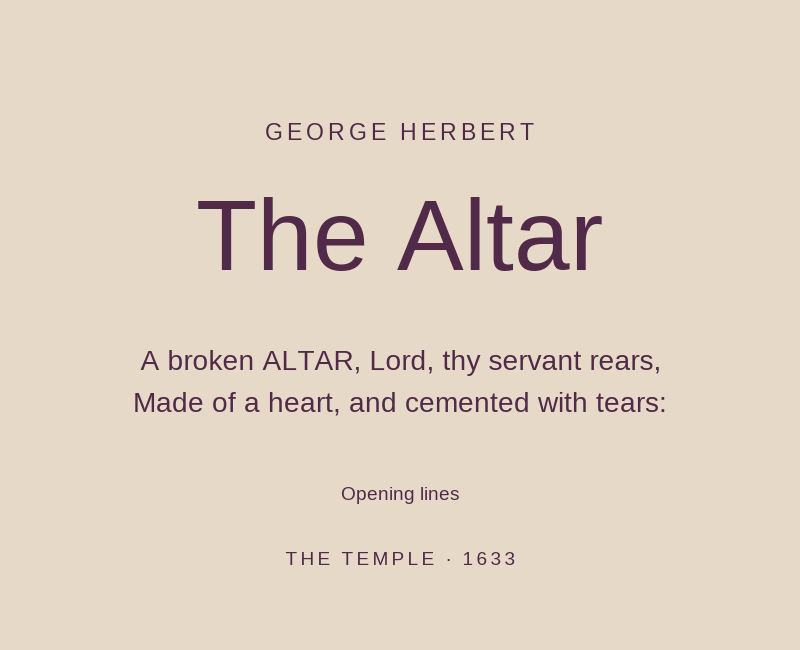
Before we read the first sentence of “The Altar”, George Herbert has asked us to look at it. Long lines at the top and bottom frame a narrow middle. The poem occupies the page as an object.
The shape is often the first thing a reader remembers. It should also be the beginning of a question. What changes when a poem about an altar tries to become one?
Herbert’s poem appeared in The Temple in 1633. Jack Lynch’s transcription identifies that edition as its copy-text and preserves the changing line lengths. The University of Toronto’s edition provides another way to read it. On a small screen, check that the layout has survived: the arrangement belongs to the work.
The material is a heart
The speaker’s building material is a broken heart. Tears serve as cement. That combination puts a difficulty inside the apparently accomplished shape. We see a carefully made literary object; we hear someone offering something damaged.
The first biblical connection is Psalm 51:16–17, where the language of sacrifice turns towards a broken spirit and contrite heart. Herbert gives that relation a visible form. The heart becomes the altar on which an offering can be made.
Another passage complicates the craft. Exodus 20:24–26 includes instructions against using hewn stone for an altar. Herbert invokes the absence of a workman’s tool, even while the poem demonstrates his own intricate workmanship.
The tension need not be solved by pretending that the poem took no skill. It is precisely the skill that makes the question interesting. How can a maker offer something to God without treating the offering as proof of the maker’s adequacy? The speaker can arrange words, but cannot confer holiness upon the result.
The short lines do work
In the narrow middle, phrases are broken into smaller units. The eye descends in brief steps. The heart is named as stone, then described as something that divine power must cut. The poem’s visible support carries an account of dependence.
At the bottom, the lines lengthen again. The speaker imagines the stones continuing to praise if his own voice falls silent. Luke 19:37–40, with its stones that would cry out, helps us hear that possibility. A material apparently incapable of speech becomes a potential witness.
These passages do not operate as footnotes pasted onto an otherwise finished poem. Their images meet inside its construction. Sacrifice, stone, heart and voice change their relation as the poem progresses.
What the finished object cannot finish
The final request is that the altar be sanctified. Visually, the object is complete. Grammatically, its last movement is a petition. The speaker has made something and still asks for something beyond the making.
That is a useful distinction for reading sacred art. Technical completion and spiritual sufficiency are different questions. Herbert allows both to exist on the same page without abandoning the labour of composition.
Read the poem once for its sentence, once for its silhouette and once for the changes in line length. The readings will overlap, but they are unlikely to be identical. Each makes a different part of the work available.
A poem this small can hold a surprising amount of architecture.
Read the poem
- George Herbert, “The Altar”, edited by Jack Lynch.
- “The Altar”, Representative Poetry Online, University of Toronto.
The biblical connections and close reading above are editorial interpretation. Herbert’s poem is in the public domain; linked modern editorial material has its own terms of use.
Read in company
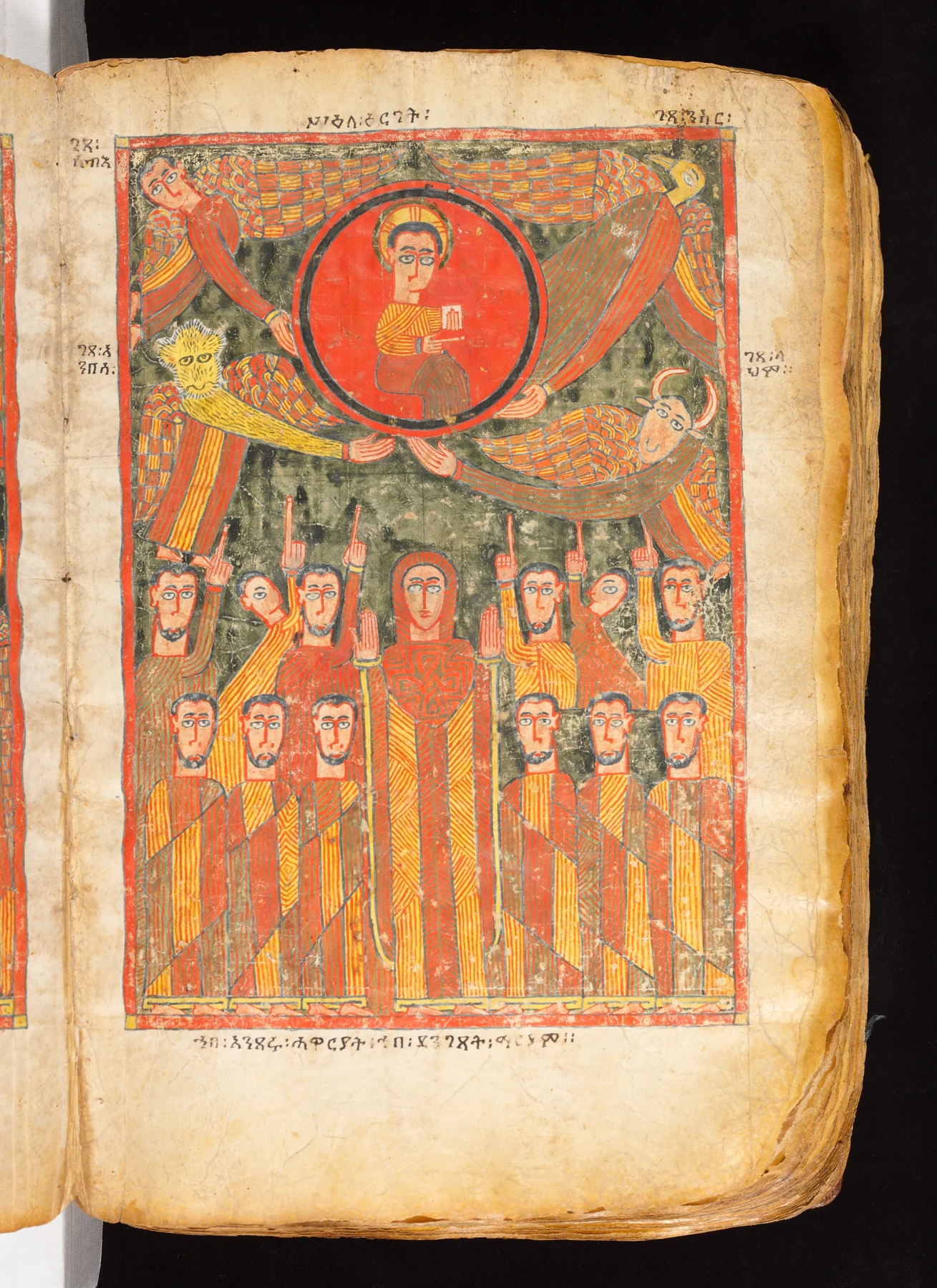
Many Tongues
A Gospel book from the Ethiopian Highlands
An Ascension image asks to be read as part of a manuscript, a local artistic tradition and a community’s worship.
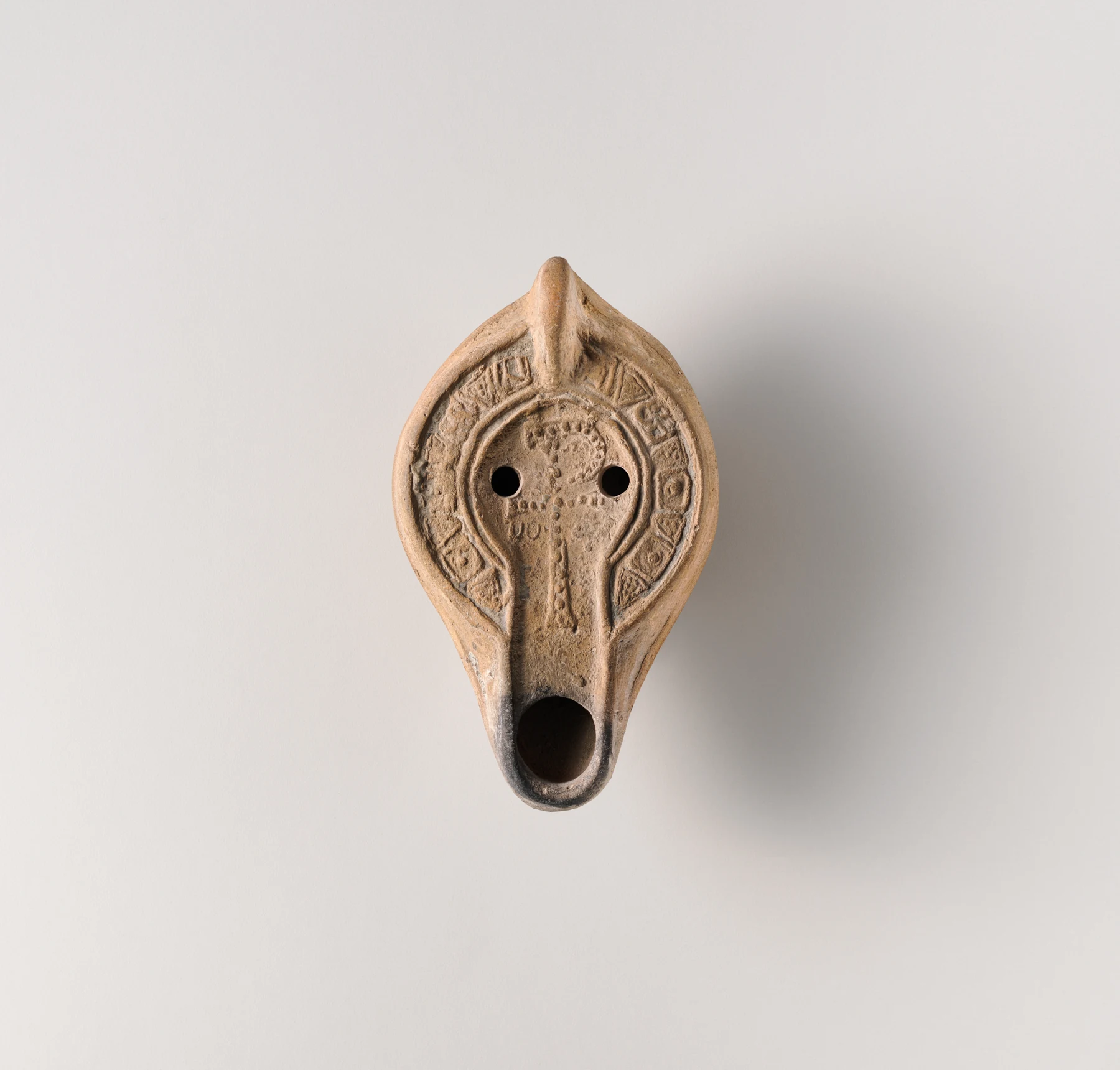
Sacred Art
A small lamp with a Christian mark
A fifth-century terracotta lamp brings Christian imagery into an object made to be filled, handled and lit.
Literature
Cain and Abel, many centuries later
One short biblical narrative becomes a history of two cities, a Romantic drama and a Californian family novel.