Literature · One Passage, Many Centuries
Cain and Abel, many centuries later
One short biblical narrative becomes a history of two cities, a Romantic drama and a Californian family novel.
Genesis 4:1–17
God asks Cain where his brother has gone. The answer is an evasion. Beneath the conversation, the ground has received blood.
The narrative of Cain and Abel occupies a small part of Genesis, but its afterlife is immense. Later writers have returned to its rivalry, rejected offering, murder and exile. Some have used the brothers to interpret the course of history. Others have opened a space for questions the biblical account leaves largely unspoken.
Our route follows three such returns. It is a reading path through a few works, rather than a complete history of the passage.
Begin with Genesis
Genesis 4:1–16 gives the brothers different occupations and offerings. God regards Abel’s offering, Cain becomes angry, and a warning follows before the killing. Afterwards, Cain fears that he too will be killed. The mark placed upon him is presented as protection against that outcome. The passage does not describe its appearance.
The narrative’s brevity has consequences. A reader has to notice what it does not supply as well as what it says. Later works may expand motives, give new speeches or transport the pattern into other lives. Those additions belong to the later works.
Keeping the source open beside a retelling is one way to see creation happening.
Augustine: the brothers become two cities
In Book XV of The City of God, Augustine places Cain and Abel within his account of earthly and heavenly communities. He notices that Cain builds a city, while Abel does not, and reads their difference through the idea of citizenship and pilgrimage.
The change of scale is striking. A conflict within a family becomes part of a theological history extending beyond the lifetime of either brother. Augustine is making an interpretive argument, drawing the passage into the larger structure of his book.
Ask what this reading brings forward. The brothers become figures through whom belonging, attachment and ultimate destination can be considered. The cost of the larger view is that the intimate scene may recede. Returning to Genesis restores the field and the unanswered question about a missing man.
Byron: a drama gives Cain more speech
Byron’s Cain: A Mystery, published in 1821, expands the story into a drama of argument and encounter. Lucifer becomes a speaking character. Cain’s questions about mortality and the world into which he has been born occupy space that the biblical narrative does not give them. The work is available in a historical edition at Project Gutenberg and in Wikisource’s transcription.
The distinction between voice and endorsement matters here. A dramatic character can make an argument without every sentence becoming the author’s declaration. The reader has to attend to the encounter among voices and to the action that follows.
Byron’s additions also change the duration of the story. Questions that occupy little explicit space in Genesis become things an audience must listen to at length.
Steinbeck: the story enters a family’s inheritance
John Steinbeck’s East of Eden, published in 1952, brings biblical patterns into the lives of the Trask and Hamilton families. The National Steinbeck Center identifies the Cain and Abel retelling within the novel’s family history. The brothers’ rivalry now unfolds through a much larger social world.
The novel also makes interpretation part of its action. Characters discuss the biblical passage and the word rendered as timshel. The publisher’s reading guide traces its role in the book’s concern with choice. We should treat that discussion as part of Steinbeck’s novel, rather than as a substitute for a linguistic study of Genesis.
One question emerges especially clearly: does recognising an inherited pattern mean being condemned to repeat it? A retelling can become a place where characters struggle with the story into which they seem to have been born.
Return to the short account
These works do not form a single agreed interpretation. Their differences are precisely what make them worth reading together. Augustine enlarges the frame towards a history of communities. Byron makes room for argument. Steinbeck explores repetition within families and the possibility of another outcome.
After them, the brevity of Genesis can feel newly forceful. The brother is still absent. The question is still being asked. Centuries of writing have gathered around the scene without exhausting it.
A reading order: Genesis 4; Augustine, The City of God, Book XV, chapters 1–5; Byron, Cain; Steinbeck, East of Eden.
Read in company
Literature
George Herbert builds an altar
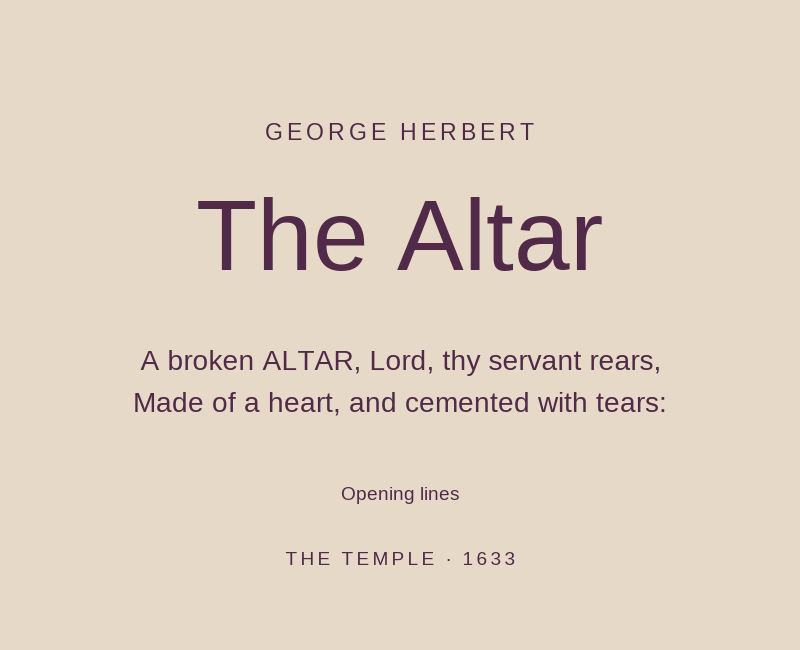
A poem’s shape can be part of its thought. Reading the stone, heart and sacrifice of Herbert’s ‘The Altar’.