Many Tongues · The Sacred Object
A Gospel book from the Ethiopian Highlands
An Ascension image asks to be read as part of a manuscript, a local artistic tradition and a community’s worship.
Luke 24:50–53 · Acts 1:6–14
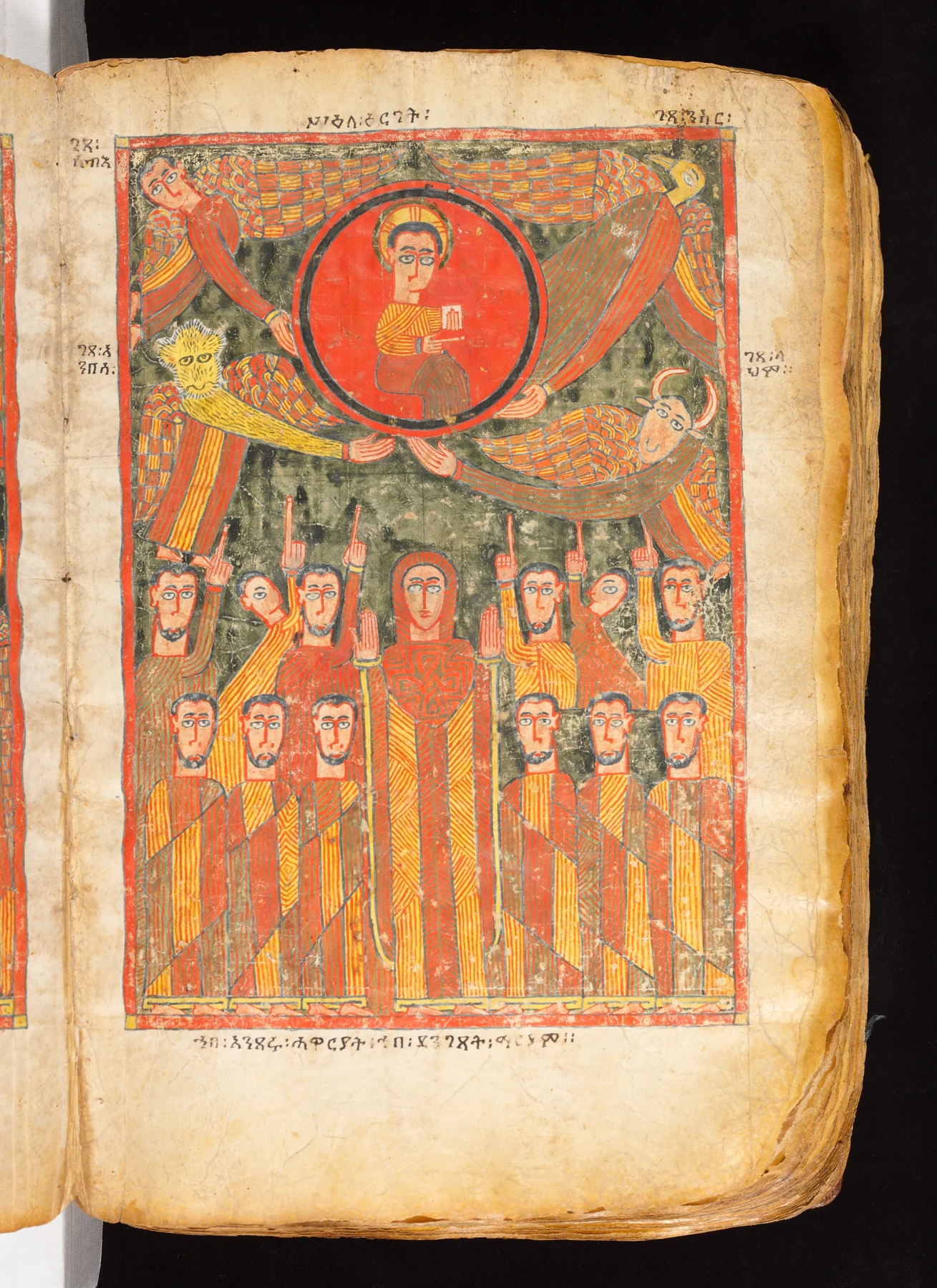
Raised fingers direct the eye upwards. Below, a group fills the page in ranks of bright garments. Above, winged figures surround Christ within a circular field. Red, yellow and dark outlines hold the scene together.
This image of the Ascension belongs to a Book of the Gospels in the Metropolitan Museum of Art, made in northern Ethiopia in the late fourteenth or early fifteenth century. The manuscript contains twenty full-page scenes and four evangelist portraits. Parchment, tempera, ink and acacia wood form the physical book.
It is tempting to reproduce a painted page as a self-contained picture. The manuscript asks for a wider view: the image has neighbouring leaves, a text, a binding and a history of being handled.
Look at the directions
The lower figures make upward movement legible without a naturalistic landscape. The pointing hands are especially direct. Their gestures establish a relation between the assembled witnesses and the upper part of the page.
The composition also creates stability. Figures are closely grouped, repeated garments give rhythm to the lower field, and strong outlines separate bodies without dispersing them. The scene has movement and order at once.
These are observations about this image. They should not become sweeping claims about every Ethiopian manuscript. A tradition is made up of particular works and makers. Looking carefully at one page is a better beginning than treating it as a sample of an undifferentiated style.
The scene and its texts
The Ascension appears at the end of Luke 24, where Jesus blesses the disciples as he parts from them. Acts 1:6–14 offers a longer sequence: departure, the disciples looking upwards, an address to them and their return to Jerusalem.
An artist has to give such a sequence a visible form. A page can hold several relations together that prose unfolds in time. Comparing the picture and passages makes those decisions perceptible without reducing the image to a diagram of individual verses.
The museum identifies the book as a product of a northern Ethiopian monastic centre and notes that its introductory miniatures were intended to be seen in liturgical processions. Its account describes inherited Byzantine forms transformed within a local artistic language. The object belongs to exchange and to particularity at the same time.
A book seen by a community
The possibility of a page being viewed in procession changes how we imagine its audience. Reading need not mean a solitary person leaning over a desk. A painted opening can be held up, recognised and encountered as part of shared worship.
We cannot recover every such encounter from a surviving manuscript. We can avoid making our own habits the only imaginable ones. The scale of an image, the clarity of a gesture and the relation between page and body all become relevant questions.
Return to the raised fingers. They guide a present-day reader looking at a reproduction, but they belong to a book made for a different community and use. The page has travelled. Its particular history deserves to travel with it.
Object record: Book of the Gospels, Northern Highlands artist, late fourteenth to early fifteenth century. The Metropolitan Museum of Art, Rogers Fund, 1998; accession 1998.66. The reproduced page depicts the Ascension. Museum record and public-domain images.
Read in company
Many Tongues
A hymn can think: reading Ephrem
A pearl in the palm becomes an instrument of theological thought. An introduction to Ephrem’s Syriac poetry.
Literature
George Herbert builds an altar
A poem’s shape can be part of its thought. Reading the stone, heart and sacrifice of Herbert’s ‘The Altar’.
Essays
What the margins ask of a reader
Why Word & Vellum begins with attention: to a text, to its readers across centuries, and to the difference between evidence and interpretation.