Archive · A Page from the Past
The Didache begins with a road
An early Christian teaching text opens with a choice of ways, then turns to the ordinary business of living together.
Matthew 5:38–48 · Matthew 6:9–13 · Deuteronomy 30:15–20
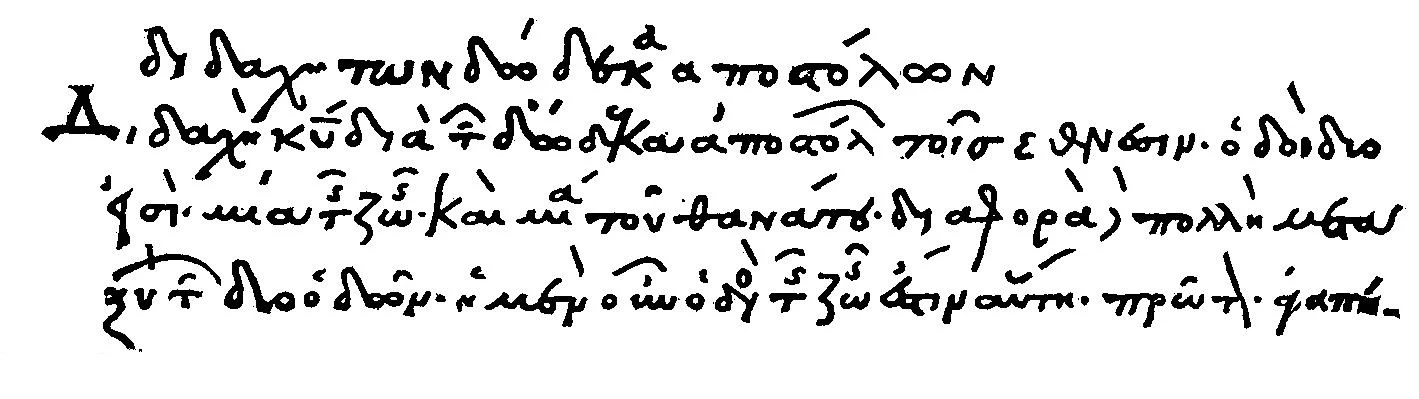
Open the Didache and the first thing you encounter is a fork in the road. There is a way of life and a way of death. The text will teach its reader to distinguish them.
The title means “teaching”. This short work brings together moral instruction, directions for communal worship and advice about recognising trustworthy teachers. Its exact date and stages of composition remain matters of scholarly discussion. The Cambridge edition’s introduction describes a compilation that developed as community needs changed. We should resist treating it as a photograph of every Christian community at one moment.
It is nevertheless an unusually direct encounter with people trying to make a shared life possible.
What a way of life contains
In the opening chapters, the road becomes a series of actions. Speech, anger, possessions, generosity and relationships all belong to the journey. The commands to love God and neighbour lead into instructions about enemies and giving. Readers familiar with the Sermon on the Mount will hear recognisable language.
The Didache also belongs within a Jewish moral inheritance. The choice between life and death already appears in Deuteronomy 30. Scholars study the opening “Two Ways” material in relation to Jewish teaching traditions; Robert Kraft’s overview at the University of Pennsylvania sets out the surviving textual relationships. Christianity’s early writing does not begin on an empty page.
For a modern reader, the image of the road gives the instructions coherence. A road is made intelligible by direction. Individual actions acquire their meaning within a larger movement, and the reader has to ask where repeated habits are taking a community.
A book that notices practical difficulties
Later sections become remarkably concrete. Chapter 7 makes provision for baptism when preferred conditions are unavailable. Chapters 11–13 address travelling teachers, hospitality and the possibility of exploitation. Prayer and material arrangements occupy the same small work. Read the surviving text in a historical translation, paying particular attention to those transitions.
There is something valuable in that change of scale. The text can move from the shape of a life to the availability of water. Its community has bodies, visitors, limited resources and decisions to make. Religious conviction has to survive contact with these particulars.
It would be easy to mine the work for unusual customs and leave it at that. A more rewarding reading asks why a rule needed to be written. A warning about a visitor implies the difficulty of welcome. Instructions about shared practice imply people who need to act together. Such questions do not tell us everything about the community behind the text, but they make its practical intelligence visible.
Reading an old handbook honestly
The Didache is a historical Christian text, not a replacement for Scripture or a shortcut around the differences between Christian traditions. Its familiarity and its distance are both worth preserving. Some sentences will sound close to words heard in church. Others will make the reader pause.
That pause is useful. It prevents the past from becoming a flattering reflection of the present. An old text can share our central commitments while organising parts of its life differently. The task is to read what it says before making it support what we already think.
Begin with the first six chapters. Notice how often the instructions concern a neighbour. Then read the sections on hospitality. The road introduced at the beginning has brought the reader to a doorway, where somebody is asking to be received.
Text and sources
- The Didache, historical English translation at New Advent, especially chapters 1–7 and 11–13.
- The Cambridge Edition of Early Christian Writings: introduction to the Didache.
- Robert A. Kraft, “The Two Ways”, University of Pennsylvania.
Read in company
Many Tongues
A hymn can think: reading Ephrem
A pearl in the palm becomes an instrument of theological thought. An introduction to Ephrem’s Syriac poetry.
Sacred Art
A small lamp with a Christian mark
A fifth-century terracotta lamp brings Christian imagery into an object made to be filled, handled and lit.