Sacred Art · The Sacred Object
Blake’s Job, before and after
In the first image, the instruments hang in a tree. In the last, the family plays them. A small change opens a way into Blake’s biblical imagination.
Job 1:1–5 · Job 42:10–17 · 2 Corinthians 3:6
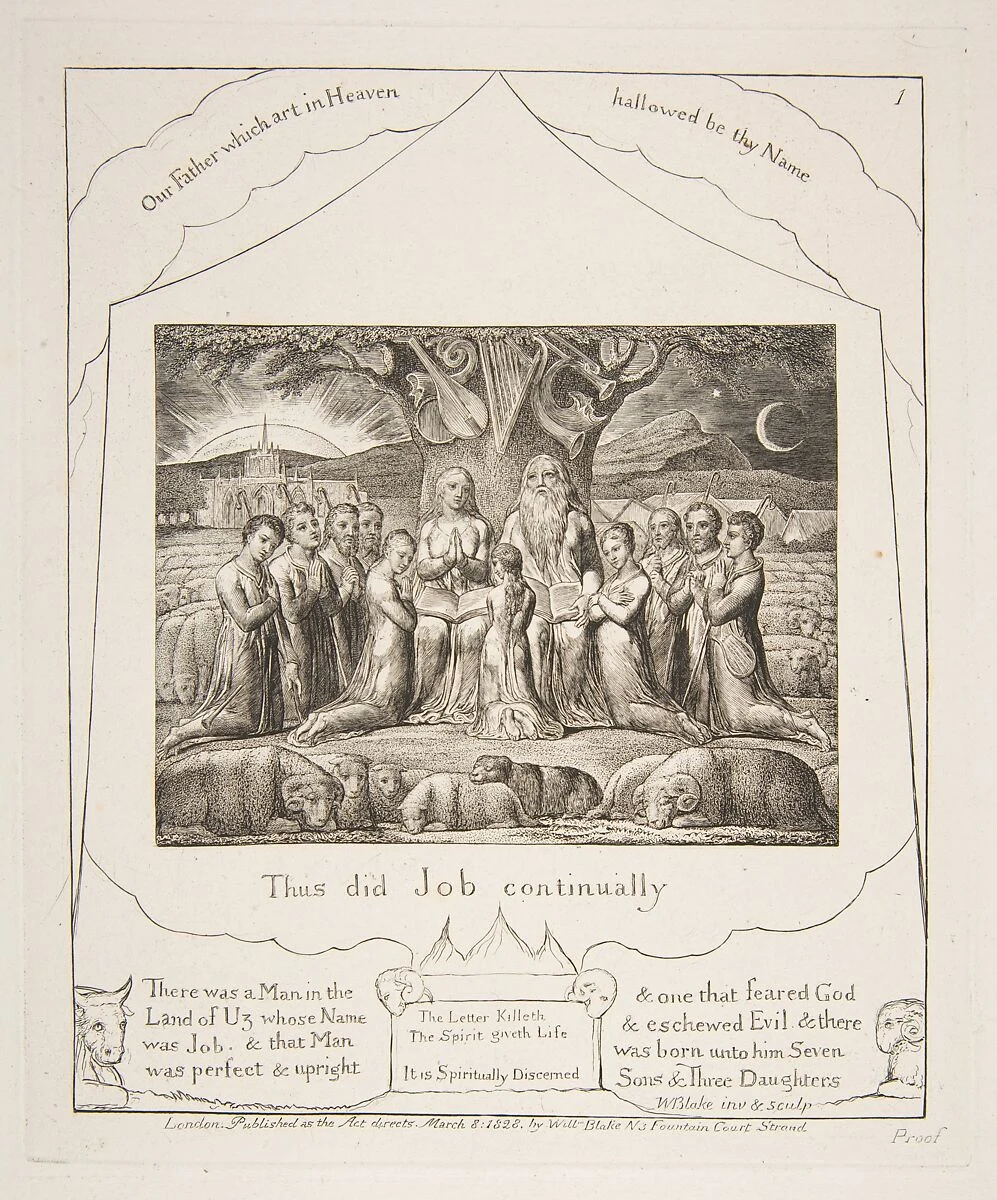
The instruments are waiting in the tree. In the first of William Blake’s engraved illustrations of Job, a harp and other instruments hang above a family gathered in worship. Job has an open book on his lap. Several figures kneel. Sheep rest in the foreground.
Turn to the last composition and the family stands. Instruments have come down from the branches into people’s hands. An arrangement that was quiet has become music.
This comparison offers a manageable entrance into a demanding series. Blake’s images are crowded with scriptural references, gestures and visual correspondences. You do not have to decode them all before looking closely at two scenes.
Two impressions, two moments
The Metropolitan Museum of Art’s Job and His Family is an engraving dated 1825–26. It includes the surrounding inscriptions as well as the central image. The National Gallery of Art’s Job and His Family Restored to Prosperity is a trial-state impression of plate 21, dated 1825, before the fully developed engraved border. The two objects therefore show different stages of printmaking as well as different moments in the narrative.
Keep that distinction in mind when comparing their margins. The absence of a border on the trial impression is evidence about that impression, not a claim that Blake’s final plate was designed to have none.
The completed engraved series appeared in 1826. The Morgan Library’s account places it within Blake’s longer work on Job and describes John Linnell’s encouragement and financial support.
What changes when the instruments move?
The biblical ending restores Job’s prosperity and describes the years he lives afterwards. Blake’s final family scene gives restoration a particular form: people make music together. Reading that choice as an account of renewed worship is an interpretation of the image. It is not an extra detail supplied by the biblical narrator.
Likewise, the unused instruments in the opening scene invite questions rather than a single automatic answer. Is this a worship capable of becoming fuller? Does Blake ask us to compare reading with participation? Why preserve the family grouping while altering what its members do?
The questions become sharper when we read the first print’s inscriptions. Below the central scene, Blake places wording from 2 Corinthians 3:6 about letter and spirit. That New Testament language appears around an Old Testament story. The artist is already arranging a conversation between biblical books.
We should be careful with what follows. A Christian artist’s use of that contrast does not justify turning Jewish Scripture into a caricature of lifeless religion. Nor does an image of an open book make books themselves the problem. The print must be read as Blake’s constructed interpretation, with all the tensions that entails.
An illustration can make an argument
The temptation with biblical art is to ask only which verse it depicts. Blake makes that question insufficient. The selection of a scene, the position of a body, the recurrence of a tree and the placement of words all help produce meaning.
Compare the figures slowly. Notice what remains: family, animals, landscape, a gathering beneath branches. Then notice the altered posture and occupied hands. The return to a similar composition makes the difference visible.
We have reached only the beginning and the end. Between them lie suffering, accusation, terror and encounter. The instruments do not explain that passage. Their movement gives us a reason to go back through it.
View the works
- William Blake, Job and His Family, 1825–26. The Metropolitan Museum of Art, gift of Edward Bement, 1917. Public domain.
- William Blake, Job and His Family Restored to Prosperity, 1825. National Gallery of Art, Rosenwald Collection. Public domain.
- The Morgan Library & Museum: Illustrations of the Book of Job.
Read in company
Sacred Art
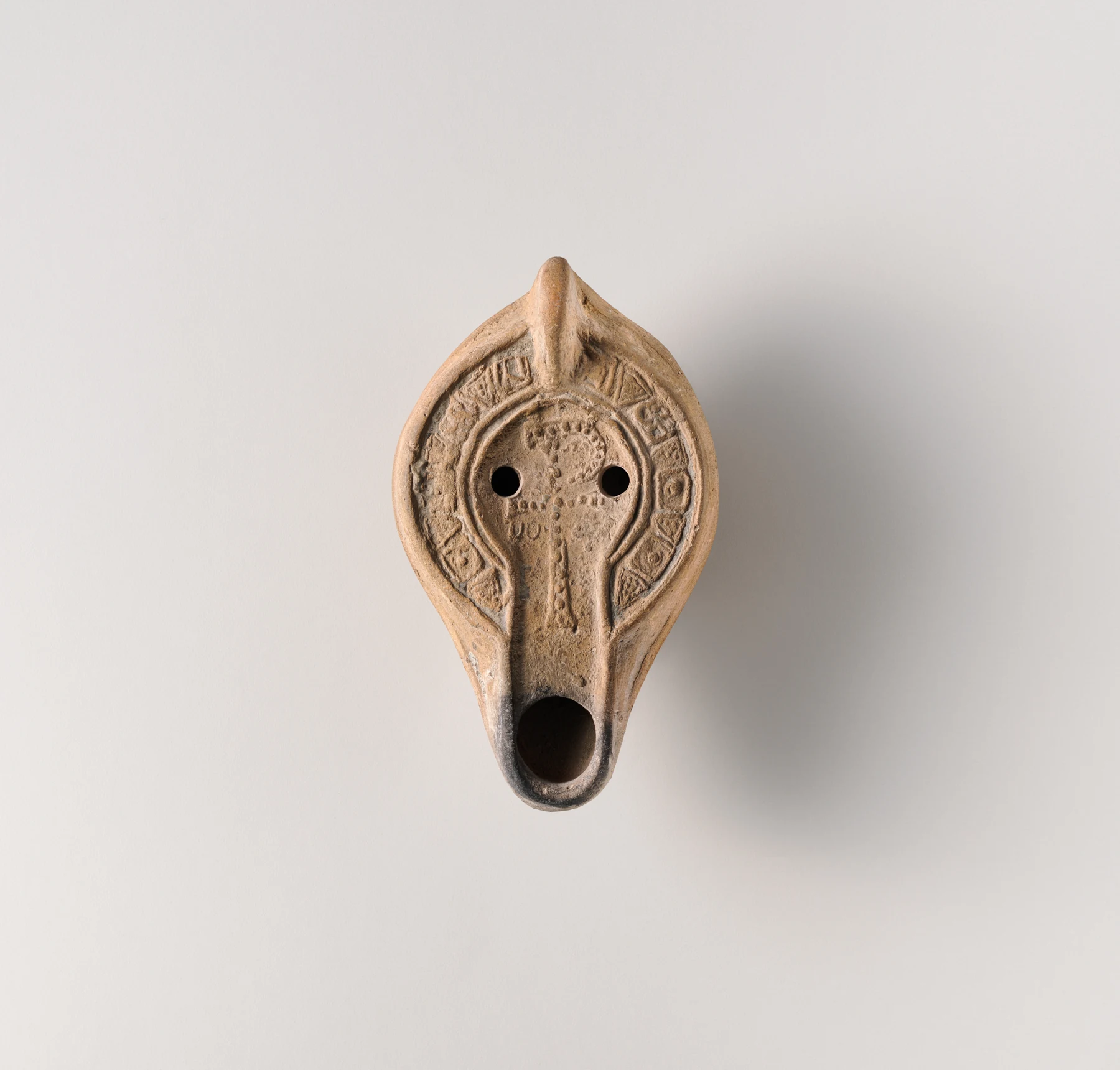
A small lamp with a Christian mark
A fifth-century terracotta lamp brings Christian imagery into an object made to be filled, handled and lit.
Scripture
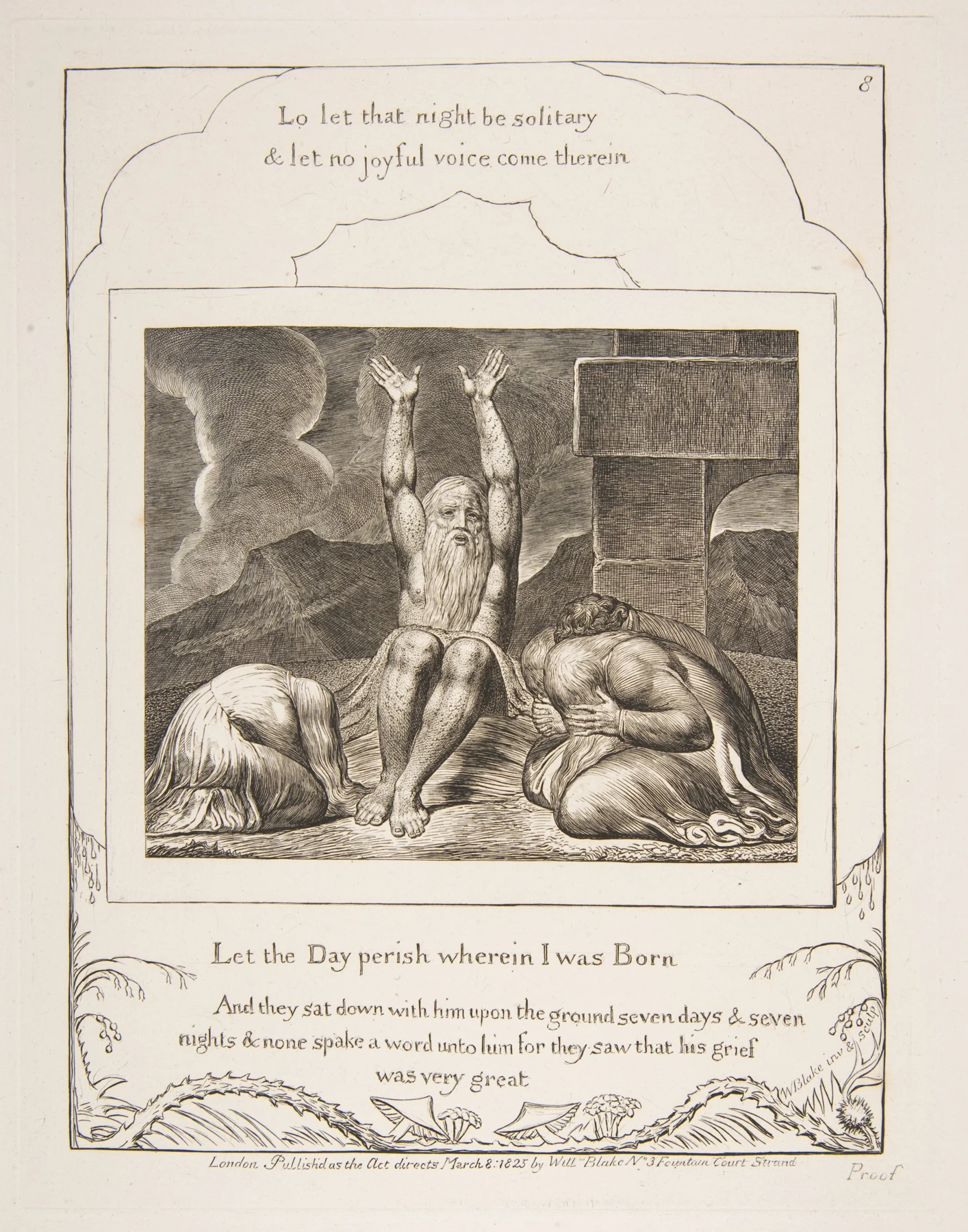
Job’s friends sat down first
Before the arguments, there were seven days on the ground. Reading the first act of friendship in the Book of Job.